

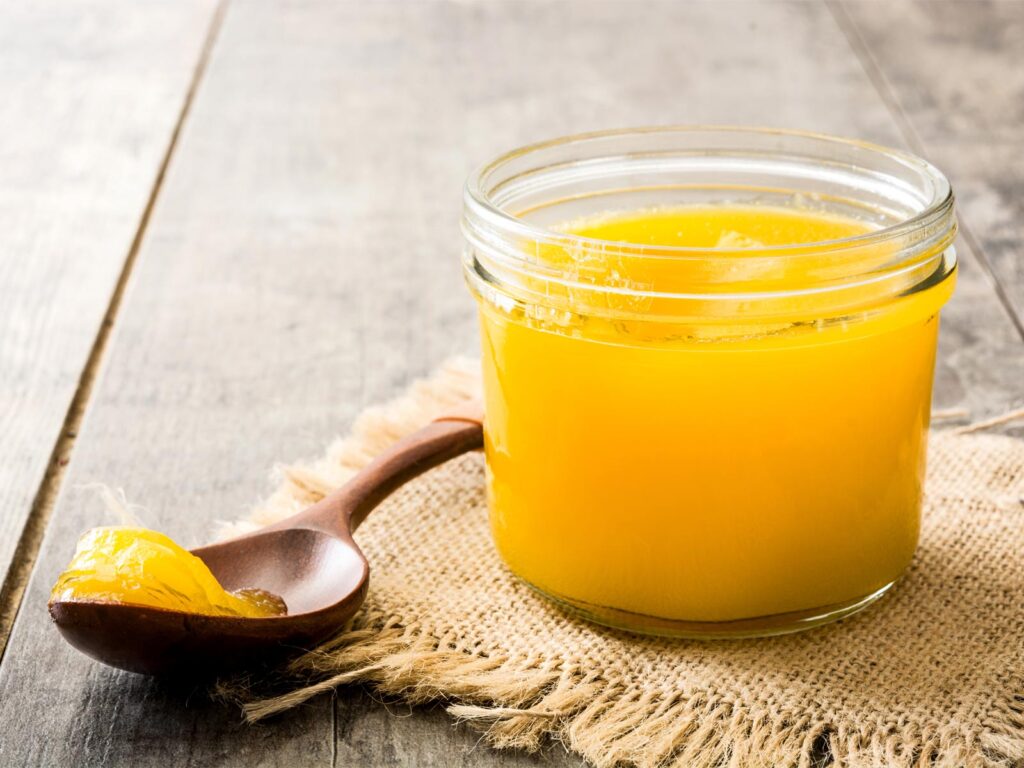
Do you love the rich, buttery silky flavor of ghee… but not the big pricetag?
Learn how to make ghee – right on your stovetop or in your slow cooker – in just a few minutes for about half the price of what it costs already prepared and packaged.
How to Make Ghee – The Ingredients & Tools
To get started, purchase several pounds of Kerrygold Unsalted Butter. In general, half a pound of butter will yield roughly one cup of ghee. You’ll also need a fine mesh strainer, lined with cheesecloth (preferred) or a paper towel and a wide-mouthed glass jar with an airtight lid.
You can make ghee on the stovetop or in your crockpot.
How to Make Ghee on Your Stovetop
Stovetop Method
- Add Kerrygold Unsalted Butter to a small saucepan and heat over medium heat.
- When the butter has melted and begins to bubble, reduce heat to medium-low and skim the foam with a spoon. Continue skimming to remove all foam (10-15 minutes).
- As the butter continues to cook, it will become darker as it condenses and the water is driven off. The milk protein will form dark clumps and sink to the bottom.
- Place the strainer lined with cheesecloth over a wide-mouth jar.
- Carefully pour the liquid through the strainer.
How to Make Ghee in Your Slow Cooker
Slow Cooker Method
- Add Kerrygold Unsalted Butter to a slow cooker. Turn the heat to the “low” setting.
- Cook on low for 6-8 hours (longer cooking time produces a darker ghee)
- You may skim the foam if you wish or simply allow it to sink to the bottom.
- Place the strainer lined with cheesecloth over a wide-mouth jar.
- Carefully pour the liquid through the strainer.
You can add a sprinkle of high quality salt (like Celtic Sea Salt or Real Sea Salt) to mimic the flavor of butter. And for a more mellow flavor, consider mixing ghee with an equal amount of organic, virgin coconut oil to make “coconut ghee”. Store in an airtight container. Ghee is completely stable at room temperature and will keep for several months or more.
Ghee provides all the flavor and health benefits of butter, but without the potential problems associated with dairy. It’s easy and inexpensive to make. And it’s one of the healthiest and most heat-stable fats you can use for cooking. While most people – including those with allergies and intolerances – tolerate ghee well, if you suffer from a severe dairy allergy, it should be avoided along with other dairy products.




Hi Kelley,
How are we sure we’re not eating farm raised fish? We are at a all inclusive resort in Puerto Vallarta in Mexico and I ask the waiter what kind of salmon they serve, was it farmed raised or from the Pacific Ocean. They told us it was from the Pacific ocean. I read on your blog that they can also farm them in the ocean? How are we to know for sure? Or what’s the question to ask?
Hi Lorraine,
Thanks for stopping by. And I hope you are having a lovely time in Puerto Vallarta while you get your vitamin D!
That is a good question, and you can find some answers about determining if fish is farm raised or wild in my post here: https://healinggourmet.com/anti-cancer-diet/no-farm-raised-fish-for-cancer-prevention/ and here: https://healinggourmet.com/organic-diet/why-you-should-avoid-farm-raised-fish/
Also, if it is “Pacific” salmon, it is usually wild; Atlantic salmon is always farm-raised. The biggest farm-raised fish are salmon, tilapia and catfish (basa). Mahi mahi can be farmed, but is typically wild.
Since you are right on the ocean, they probably have some great fresh local fish like Snapper and Mahi-Mahi. I would ask your waiter what the fresh catch is and when it arrived. And opt for the smaller species I mentioned versus larger (like tuna or marlin) to avoid higher levels of mercury and pollutants.
Hope this helps and enjoy!
Kelley
Thank you so much for your super quick reply. This will help a lot.
Lorraine